- Just Curious: Applied AI for PE and Mid-Market Leaders.
- Posts
- The CFO’s AI Playbook: Fix Data Flows First
The CFO’s AI Playbook: Fix Data Flows First
Michael Cohen on why finance should act like a data team, and how one $50M manufacturer saved $500K, and another found $10M in three days.

Stuart Willson
November 05, 2025

This is the newsletter of Just Curious, the world’s leading network of applied AI experts. We connect operators and investors with proven partners to design, build, and deploy AI solutions that drive measurable growth, efficiency, and innovation.
You can submit your needs here. We’ll anonymize them and return 5–15 expert perspectives from our network. It’s free.

Michael Cohen, Managing Director @ Stalliant
Most CFOs don’t have a data problem, but they do have a data flow problem.
This week’s guest, Michael Cohen, Managing Director at Stalliant, operates at that intersection: half engineering, half finance.
His team helps PE-backed companies replace shadow processes with connected finance systems that actually work, all using the tools their teams already know.
“The modern finance department,” he told me, “is more like a financial intelligence department.”
That mindset has helped middle-market clients cut reporting time in half, reclaim thousands of analyst hours, and in one case, save $500K a year by eliminating Excel workarounds and linking finance data directly into QuickBooks and Power BI.
Michael’s measured and technical approach is a reminder that you don’t need a moonshot, just stable data flows, clear ownership, and a first win that sticks.
What to expect:
Why CFOs should think like data engineers
How one $50M manufacturer freed up 50% of a COO’s time
The case for connecting, not replacing, your finance systems
$500K annual savings from automating Excel exports
How two engineers generated $10M in savings in three days
The real risk behind “AI for finance” hype
How to use Power Query to eliminate shadow processes
Recently / Coming Up on Just Curious
Natalia Quitero, Every — From Playtime to Production: How Every Builds AI That Teams Actually Use
Csongor Barabasi, Bonsai Labs — From POC to 7-Figure ARR in 6 Months: Bonsai Labs’ AI Playbook for PE-Backed Companies
Jordan Guerrieri, BlueLable — How to Turn AI Experiments into Enterprise Systems—Lessons from 300+ Deployments
Coming up: Tau9Labs, Marble AI, Tenex, and many more
Watch the full interview with Michael Cohen
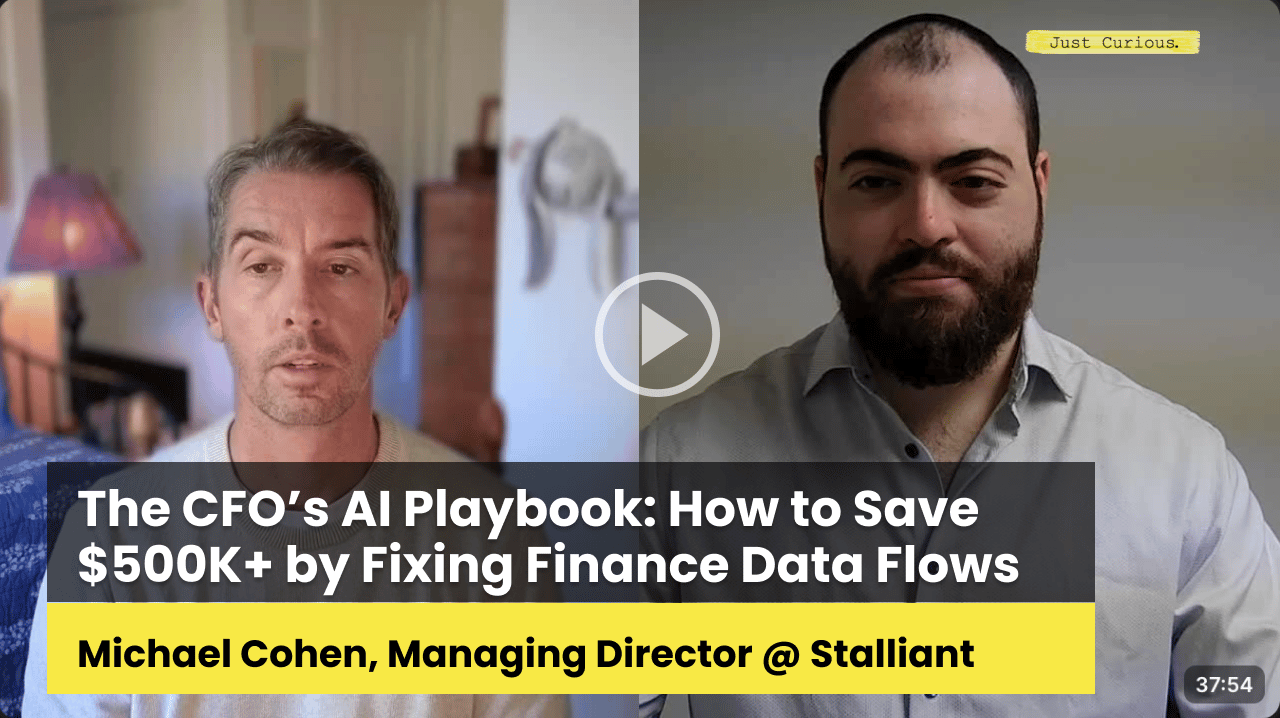
Expert Q&A: Michael Cohen, Managing Director @ Stalliant
Each week, we ask our applied AI experts five questions to surface their frameworks, lessons, and operator insights. Michael’s answers follow, paired with Stu’s thoughts from our full conversation.
Michael lives at the intersection of finance and data engineering, building connected systems that let CFOs see, decide, and act in real time.
1. Describe who you are, what you do, who you do it for, and what makes your approach unique.
“I am the Managing Director of Stalliant, and our ultimate goal is to reinvent the office of the CFO, optimizing the finance function to be the intelligence center of any middle-market business.
We generally work with PE-backed companies from $10M–$200M in revenue. My personal focus is on strategizing solutions for “legacy” businesses in the industrial sector — niche manufacturing, distribution, etc.
Our approach blends finance and technical expertise within one team.
Each of our directors is a finance professional with data skills, and each of our engineers is a data specialist given accounting and finance training in-house.
This enables us to build quickly and stably inside the finance and operations functions, rather than creating another silo through an IT bottleneck, which is where most projects stall out.
We build modularly, starting with minimum necessary tech and no extra SaaS layer. Each module can be operated internally and is built to support the next.”
Stu’s Thoughts:
Most middle-market CFOs sit between two broken languages, finance and IT. Stalliant speaks both.
That gap is more than just semantics; it creates a structural drag.
In Michael’s words, “The culture in finance teams hasn’t been very pro-automation — and IT and finance weren’t speaking the same language.”
The result is what he calls “shadow processes,” manual spreadsheets and CSV exports that fill the void between ERP systems and board reporting.
Those workarounds are invisible until the numbers don’t match across departments, and by then, the damage is done.
Stalliant’s hybrid model eliminates that gap. Every team member can build a data pipeline and read a balance sheet. That dual fluency means they can work inside the finance department, not around it, connecting Excel directly to source systems instead of launching a new platform.
For operators and PE owners, that’s a compounding advantage: fewer translation costs, faster adoption, and clean data that the CFO can actually stand behind.
2. What problem are you most focused on solving right now, and how are you anticipating solving this problem with AI?
“In middle and lower-middle markets, finance answers everyone’s questions — and it’s their reports that provide the information needed for decision-making.
This is nearly always an ad hoc, manual process. It works early on, but not as the company scales. The finance department becomes overwhelmed, especially in owner-operated businesses receiving institutional capital for the first time. They often can’t get to the level of detail needed for nuanced decisions — and certainly not fast enough.
Data fundamentals are a natural partner to finance. Stable automation can handle 95% of the information movement — exporting, cleaning, formatting, pivoting — and give time back to the strategic side.”
Stu’s Thoughts:
Michael calls this “fixing the data flow before the data.” He’s seen the same bottleneck in every $20M–$100M portfolio company: finance buried in spreadsheets, unable to see the business in real time.
He described a Midwest manufacturing client where the COO spent half his week building reports.
After Stalliant connected Excel directly to QuickBooks with Power Query, that time dropped to near zero, saving roughly $500K a year in time and efficiency.
“The win,” Michael said, “wasn’t in new tools. It was in connecting the old ones.”
That connection-first mindset turns finance from a cost center into an information engine, the kind that makes faster, cleaner decisions portfolio-wide.
3. Where have you seen AI drive the fastest ROI?
“We sent a two-person team that used data modelling and engineering to ingest NetSuite data for report creation.
In about three days, based on the insights we showed into inventory sales, the CFO made the decision to cut the stagnant long-tail product lines and invest into an inventory management system.
At a very conservative estimate, this would save them $5–10M in 2026 by savings on COGS and tariffs, and generate 3x that amount by focusing on high-demand products.
Stu’s Thoughts:
Three days. $5–10M of savings.
Stalliant doesn’t lead with leads with visibility no “AI.”
Michael told me, “Once the data’s clean and connected, decisions happen fast.”
In this case, two engineers built a lightweight data model to surface inventory trends in NetSuite.
Within 72 hours, the CFO saw what had been hiding in plain sight: 20% of SKUs were driving 80% of gross profit, while the long-tail products were tying up millions in inventory and tariff costs.
That clarity was enough to justify cutting the bottom quartile of SKUs and reinvesting in higher-turnover lines, a move projected to save $5–10M in 2026 and generate three times that in growth.
The lesson here is the importance of access.
When data engineering is embedded in finance — not outsourced to IT — insight turns from a quarterly exercise into a continuous process. Stalliant’s approach compresses the lag between data and decision.
For operators and investors, that means organizational and portfolio visibility you can act on mid-quarter, not months later when the window’s closed.
4. What’s the most common mistake companies make when they try to “do AI”?
“Two sentences: Start with mature, vetted technologies that have been around since before 2022. Then, if and when it’s necessary, look at LLMs.
AI is a massive umbrella term. The biggest mistake that companies can make is not taking the time to define the specific technologies/methodologies in play.
99% of the time, a company will make a push for “AI” and one group will take that to mean LLMs (ChatGPT, Claude, etc.), one group will think about classic machine learning, one group will push for RPA — and many “AI vendors” will offer basic data ingestion and call that AI.
In one LinkedIn post, I saw an “AI” SaaS tool offering automatable web browsing, complete with guided mouse clicks and filling text fields, entirely indistinguishable from the functions that Zapier and Power Automate have had for years. There are many examples like this — nothing AI about it.”
Stu’s Thoughts:
When we spoke, Michael warned of what he calls “the tools-first trap.” “You can spend years getting your data perfect,” he said, “and still need a custom dataset for every use case.”
That trap shows up every quarter inside PE portfolios: a finance team chasing data cleanliness while nothing moves to production. The sequence is backwards. They start with “AI readiness” instead of business readiness. Stalliant flips that order. Before a single model is trained, they map deterministic flows: what decisions repeat daily, which inputs are structured, and which outputs must be identical every time. Those become code and connectors.
More bluntly: “Nearly 100% of finance workflows can be automated without a large language model.”
His team starts with Power Query, Fabric, and rule-based automation, tools that return the same answer twice. Only once those foundations are stable do they layer in language models for reasoning or text synthesis.
That’s not anti-AI; it’s disciplined sequencing. Crawl with code, walk with automation, and run — only when you’re ready — with models. It’s the difference between a one-off pilot and a finance system you can sign off on at quarter close.
5. What’s a surprising, non-obvious workflow where AI created real leverage?
“For workflows specifically, I like to refer to emails. LLMs are phenomenal at ingesting and synthesizing large amounts of text and turning that into a binary function (yes/no) or a flag.
Using LLMs to process incoming text and using predetermined categorization criteria to flag the message and run a traditional if-then workflow is by far the best use I can think of for AI.
These days, I am much more bullish on AI for personal productivity. Using AI allows us to learn much faster — as long as we recognize the danger of learning from summaries and headlines, and use these tools as gateways to knowledge rather than a source.”
Stu’s Thoughts:
Michael sees value where text meets judgment. In one client pilot, his team used GPT to classify hundreds of vendor and customer emails, automatically routing them into Power Automate workflows. That simple layer freed up days of manual triage each month.
But his larger point stands: “AI should accelerate understanding, not replace it.”
It’s a reminder to operators and investors that the best automations are often boring, measurable, and built on data you already trust.
Key takeaways
Map every manual export, pivot, and CSV. That’s your hidden data flow cost.
Connect Excel to your source systems before replacing them. Power Query > new ERP.
Define “AI” precisely. Treat deterministic automation and LLMs as separate toolsets.
Connecting with Michael
Here are a couple of options:
Respond to this newsletter, and we’ll help facilitate (it’s free)
Check out Michael’s Just Curious profile and connect with him there (also, free)
Explore Stalliant: https://www.stalliant.com/