- Just Curious: Applied AI for PE and Mid-Market Leaders.
- Posts
- From POC to Production: Csongor Barabasi’s Fast-Fashion Playbook for AI in PE-Backed Software
From POC to Production: Csongor Barabasi’s Fast-Fashion Playbook for AI in PE-Backed Software
How Bonsai Labs helps B2B software companies ship AI products in months and turn them into real ARR. Plus: this week’s member offer on a focused Data & AI Opportunity Strategy Sprint.

Stuart Willson
November 25, 2025

This is the newsletter of Just Curious, the world’s leading network of applied AI experts. We connect operators and investors with proven partners to design, build, and deploy AI solutions that drive measurable growth, efficiency, and innovation.
You can submit your needs here, we’ll anonymize them, and return 5–15 expert perspectives with pricing from our network. Think of it like a “Mini RFP.” And it’s free.

Csongor Barabasi, Co-Founder & CEO @ Bonsai Labs
Csongor Barabasi has a clear lens on how PE-backed software companies can win with AI: fast cycles, deep domain understanding, and an obsession with measurable ROI.
As founder and CEO of Bonsai Labs, he and his team have helped some of the world’s leading PE firms turn pilots into production systems, often in 3 months to beta and 6 months to general availability, with multi–seven-figure ARR following close behind.
What stood out in our conversation: “If you just build the product and hope people will use it,” he told me, “it won’t stick.”
AI isn’t just a “tech build.” It’s people, process, and product.
That integrated approach has powered everything from AI-powered legal assistants to 90%-automated service delivery workflows inside mature tech-enabled services companies.
And while market noise is at an all-time high, his advice to leaders is clear: move fast, but measure faster.
What to expect:
The “fast-fashion moment” in software and what it means for PE-backed operators
How Bonsai Labs takes AI products from idea → beta in 3 months → GA in 6
A legal AI assistant that hit seven-figure ARR by month six
Why AI transformation fails without people and process redesign
How to scope use cases when analytics are incomplete
The quiet risk in most POCs, and why leaders must “stop falling in love with them”
Before we begin… As you may have seen, we’re introducing our first-ever Just Curious member offer: a focused, two-week Data & AI Opportunity Strategy sprint from a leading Data & AI Consultancy. We’re making it available at 50% off for the first three firms who reply. More on that toward the end of today’s issue.
Watch the full interview with Csongor Barabasi
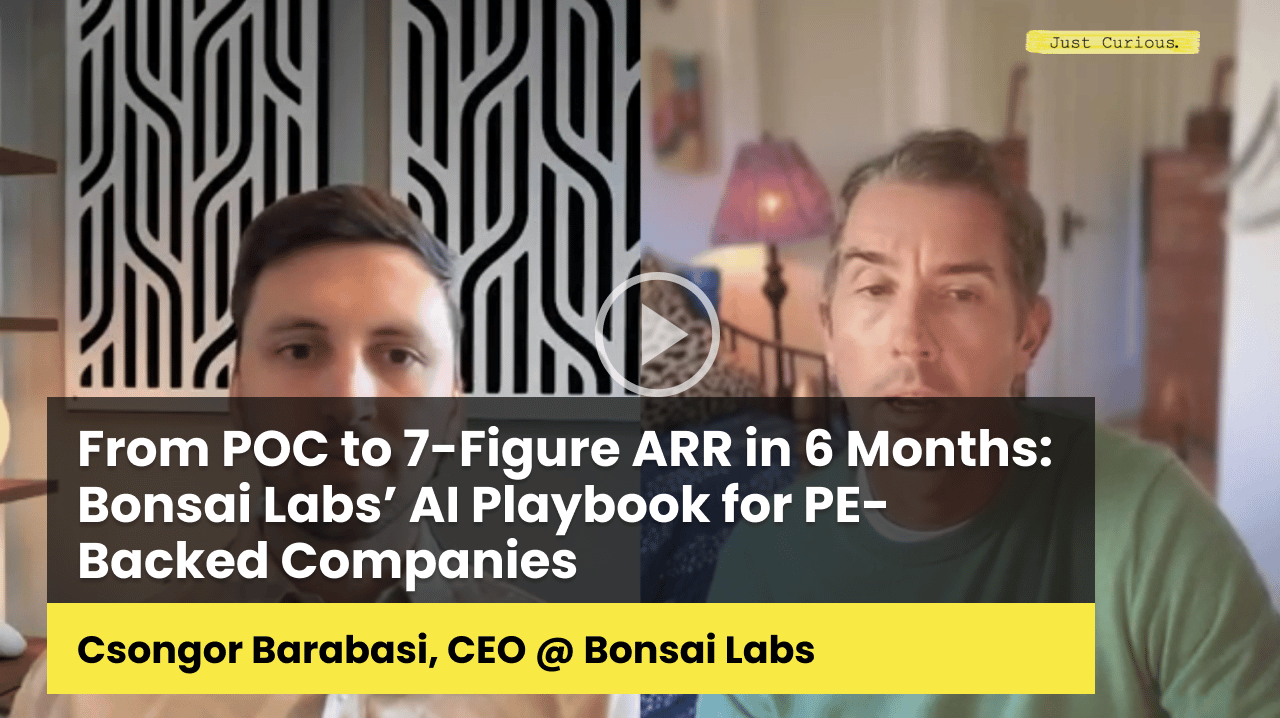
Expert Q&A: Csongor Barabasi, Co-founder & CEO, Bonsai Labs
Each week, we ask our applied AI experts five questions to surface their frameworks, lessons, and operator insights. Csongor’s answers follow, paired with Stu’s thoughts from our full conversation.
Csongor specializes in the hardest part of AI: taking complex domains, stripping them to first principles, and shipping production-grade systems in weeks—not quarters.
1. Describe who you are, what you do, who you do it for, and what makes your approach unique.
“I’m Csongor Barabasi, founder/CEO of Bonsai Labs. We’re an AI implementation and transformation company that works with enterprises to take AI pilots into production.
We predominantly work with PE-backed B2B Software and Tech-Enabled Services companies, helping them build custom AI workflows and software products.
What makes us unique:
PE value creation background — we understand PE needs, timelines and how they think about ROI.
Team of ex-founders and operators, delivering at a pace that’s unheard of among agencies.
We take a holistic approach to AI implementation. We don’t only build technology, we support you in assessing AI’s impact on your business model, we build the tech, and we help you drive the change management or market roll-out required.
Stu’s Thoughts:
Why this matters: Csongor’s model is built around the real constraint in PE — delivering impact fast without sacrificing reliability.
In PE-backed environments, you don’t get 18 months to experiment. You need progress in weeks, tangible results in quarters, and a first project that actually works.
Move too slowly and you miss the value-creation plan; move too fast with something brittle and you damage trust with customers and internal teams. That intersection, speed and reliability, is the real constraint.
In our interview, Csongor walked through how his team built a legal research assistant—indexing millions of documents—in under 12 weeks, reaching paying customers by month three. That speed only works because the engineering discipline is there: weekly iteration cycles, eval-driven scoring, and domain experts embedded beside the engineers to shape logic, prompts, and correctness criteria.
“We’ve been doing AI way before it was cool.”
Not bravado. It is shorthand for their operating model: rebuild the process, retrain the people, then insert the product. Long before GenAI hype, Bonsai worked like a mature ML organization, domain experts embedded with engineers, evals baked into every iteration, and reliability defined up front. That’s why they treat AI implementation as an organizational rebuild, not a feature build. And it’s why their systems don’t stall at pilot — they clear the reliability bar, hit production, and start generating measurable ROI inside one or two quarters.
2. What problem are you most focused on solving right now, and how are you anticipating solving this problem with AI?
“One of the core challenges we’re working on right now is transforming the service delivery model of a Tech-Enabled Service business.
More than 50% of their work is manual and repetitive, so our challenge is to 1) identify the best opportunities to start with, 2) estimate ROI when sometimes the analytics data is not available, 3) assess if you map the current process to AI automation or you have to create a more efficient process from scratch.
If this works out, we will help our client deliver some services 90% by AI with 10% human review, massively increasing their operating margin for low-value services, and also significantly cut down manual service time on the more complex services.
We’re using LLMs, browser agents, and voice AI in these processes.”
Stu’s Thoughts:
The “90% AI / 10% human review” target Csongor described isn’t just an efficiency goal. It tells you something about the nature of the work.
To get a workflow to 90% automation, you can’t simply bolt AI onto the existing process. You have to re-map the steps, standardize the logic, and redesign the workflow so AI can reliably handle most of the load.
That’s why this line from our conversation stood out: “You have to understand the process, then reimagine it with an AI-native lens.” The reimagination step is what makes 90/10 possible. Most teams skip it and end up with an automation that can’t scale beyond a narrow POC.
For operators and investors, the implication is concrete: when a workflow is rebuilt for an AI-first model, margin expands on low-value services, and the throughput of high-value work increases, not because AI is “smart,” but because the underlying process is finally designed to support automation.
3. What’s one thing you wish every CEO understood before they invested in AI?
“I wish every CEO would have a partner (internal or external) who can do an X-ray of their business, and present a list of all the automation opportunities with $$$ ROI attached to them.
It takes minimum investment, and can save months of piloting the wrong thing or investing in the wrong initiative.”
Stu’s Thoughts:
This is the part of the conversation that should be obvious, but almost no leadership team behaves this way in practice.
Most companies are still “deploying AI” rather than looking for problems worth solving, and the result is predictable: low adoption, and more importantly, low levels of value creation. People don’t adopt tools that don’t solve real work.
That’s why Csongor pushes CEOs to run a 4–6 week X-ray of the business first. Map the workflows, quantify the value, and only then decide what (if anything) should be automated. He’s seen teams debate data readiness for six months only to learn their first AI product didn’t need a warehouse; it needed a clearly defined problem.
Identify the value first, not the architecture.
Companies that start with “What should we automate?” get stuck. Companies that start with “Where is the pain?” build things people actually use.
Everything else — tooling, models, infra — is sequencing.
4. What’s a surprising, non-obvious workflow where AI created real leverage?
“We built an AI-powered quoting engine for a public-sector services firm that identified and priced opportunities faster than competitors, giving them a real edge in winning deals.”
Stu’s Thoughts:
This example mirrors a theme that came up repeatedly in our interview: the workflows leaders assume are “too bespoke” for AI are usually bottlenecked by speed, not complexity.
Quoting feels complex, but the real constraint is cycle time. If you can identify and price an opportunity minutes—or hours—faster than competitors, you materially increase your win rate.
Csongor described how many executives treat quoting as an art. But once his team mapped the decision rules, patterns appeared that humans hadn’t articulated. As he put it, “You just have to ask the naïve questions.” That’s domain understanding at work. Once the logic is clear, AI doesn’t need to be brilliant. It just needs to be fast and consistent, pulling data, comparing cases, and drafting a quote in seconds instead of hours.
If a workflow impacts revenue outcomes, not just efficiency, it’s a front-of-the-line AI candidate.
These are the places where reducing cycle time—often by 90% or more—delivers leverage that complexity alone never blocked.
5. Where have you seen AI drive the fastest or best ROI?
“B2B Enterprise Software innovation drove the largest ROI we’ve seen.
Support the product and engineering leadership through product discovery to identify the best AI opportunities to invest in.
Build the tech incredibly fast — 3 months to beta, 6 months to general availability of full-blown AI product.
Already signed multi–7-figure ARR by beta, huge EV-expansion, company can tell their AI story, increase exit likelihood.”
Stu’s Thoughts:
This is the case study many readers will remember: Bonsai helped a legal tech company launch an AI research assistant that reached paying customers in month three and seven-figure ARR by month six.
What stuck with me from our interview was the KPI that determined whether the product lived or died: first-answer correctness. If the assistant’s first response was accurate, lawyers trusted it. If it missed—even slightly—they abandoned the tool and defaulted back to ChatGPT.
That single metric changed how the entire product was built.
Csongor’s team indexed millions of documents, worked directly with in-house lawyers to define “correctness,” and benchmarked performance weekly.
They didn’t wait to retrofit reliability later. They designed for trust from day one.
By the time they reached GA, it wasn’t a prototype or an experiment. It was a line of business with a defensible moat built on speed, accuracy, and proprietary data.
Their playbook:
Pick a product surface area tied directly to revenue or renewal pressure.
Build fast, but benchmark even faster.
Define the trust bar early.
Ship something that customers can pay for, not just demo.
Pilots don’t drive enterprise value. But when AI becomes a revenue line, the exit multiple follows.
Key takeaways
Run a 4–6 week “AI X-ray” across workflows with ROI estimates instead of starting with architecture or tooling debates.
Redesign processes before automating them. Don’t map today’s inefficient workflow into an agent; rebuild the workflow with an AI-native lens first.
Benchmark reliability weekly. Adopt simple evals (precision, recall, first-answer correctness) so your team knows whether they’re on the path to production, not trapped in POC land.
Member Offer: Data & AI Opportunity Strategy (50% Off)
Are you a private equity or private credit leader trying to determine where data and AI can actually drive meaningful leverage? In sourcing, underwriting, portfolio oversight, or fund operations?
We’re launching the first offer from the Just Curious Network — a two-week engagement delivered by a leading Data & AI consulting firm that works exclusively with private equity and private credit. The goal: help your team identify the highest-value, lowest-friction ways to apply data and AI, and develop a plan you can execute in months, not quarters.
This introductory offer is available at 50% off for the first three firms who reply.
What you’ll gain:
A prioritized roadmap of 3–5 high-impact AI + data use cases tied directly to your workflows
A buy-vs-build analysis showing what should be built internally vs. sourced from vendors
A phased 3–6 month implementation plan with clear sequencing, dependencies, and org enablers
A final presentation + written report for partners, CIOs, and portco leadership
Valued at $15,000 — offered for $7,500.
Available only to the first three qualified firms that respond in the next two weeks.
If you'd like details, just reply “Strategy.”
Connecting with Csongor
Reply to this email, and I’ll facilitate an intro (free).
Check out Csongor’s Just Curious profile: https://www.justcurious.io/experts/csongor-barabasi
From POC to 7-Figure ARR in 6 Months: Bonsai Labs’ AI Playbook for PE-Backed Companies
Website: https://bonsai-labs.com/